Language


Development of non APP halogen-free flame retardant oil filled SEBS/PP elastomer material
Preparation of APP-free Oil-extended Halogen-free Flame Retarded SEBS/PP Thermoplastic Elastomer
HU Zhi 1,2
(1. Chongqing Copolyforce New Materials Co, Ltd, Chongqing 401332, China; 2. Chongqing Research Institute Co. Ltd of China Coal Technology & Engineering Group Corporation, Chongqing 400037, China)
Abstract:The flame retardant oil-extended SEBS/PP was prepared by adding an APP-free intumescent flame retardant (FR-1420). The effect of dosage on flame retardance and mechanical properties in SEBS/PP were studied. The thermal behaviors were evaluated by thermogravimetry analysis (TG). The results showed that the FR-1420 improved the vertical burning test level of SEBS/PP composites. A UL-94 V-0 grade was realized when 20 wt.% FR-1420 was added to the 3.2 mm SEBS/PP samples without oil addition. The addition of oil can adjust the hardness of the material, but the flame retardance and mechanical properties of the SEBS/PP reduced. The TG analysis proved that the addition of FR-1420 decreased the initial decomposition temperature but increased the char residue; the addition of oil decreased the initial decomposition temperature, but it does not affect the char residue amount.
Key words:SEBS/PP; Thermoplastic elastomer; Halogen-free; APP-free
Thermoplastic elastomer (TPE) has developed rapidly in recent years and is widely used in mining, construction, automotive and other fields due to its high elasticity, aging resistance, oil resistance and other characteristics of traditional rubber, as well as the easy processing and molding of thermoplastic materials [1-3]. Styrene ethylene butadiene styrene block copolymer (SEBS) is a styrene based TPE that exhibits better ozone and oxidation resistance than hydrogenated styrene butadiene styrene block copolymer (SBS) by selecting the unsaturated double bond of butadiene in SBS. In practical applications, polypropylene (PP) is generally blended and used in the form of SEBS/PP elastomer to improve the problems of high rigidity, high viscosity, and high price of SEBS. At the same time, according to the needs of different industries, softening agent oils such as white oil and cyclohexane oil will also be added [4-6] to improve their fluidity and hardness.
SEBS/PP elastomers themselves contain flammable components such as styrene and polyolefins, with low oxygen index and easier combustion after oil filling. Therefore, in application scenarios with high flame retardant requirements, flame retardant treatment must be carried out [7]. By using flame retardant systems such as bromine containing flame retardants [8], inorganic flame retardants [9], and phosphorus based flame retardants [10], SEBS/PP elastomer materials can achieve good flame retardancy. However, there are certain problems, such as environmental issues with bromine antimony systems and excessive addition of inorganic flame retardants. At present, the expansion type flame retardant generates a carbon layer on the surface of the material through solid-phase carbonization mechanism, which can provide thermal insulation and oxygen isolation, achieve flame retardant effect, and have the advantages of low smoke and low toxicity, becoming a hot research and development topic [11]. Traditional expansion flame retardants usually contain ammonium polyphosphate (APP), which has problems such as strong moisture absorption and low heat resistance [12]. This article investigates the flame retardancy and mechanical properties of oil filled halogen-free flame retardant SEBS/PP elastomer materials (with a mass ratio of SEBS to PP of 1:1) by adding a new non APP expanding flame retardant FR-1420 [13] (piperazine pyrophosphate system). The thermal decomposition behavior of the material is studied through thermogravimetric analysis.
1 Experimental section
1.1 Main raw materials
SEBS,YH501, Chongqing Baling Chemical Co., Ltd; PP,BX3900, SK Korea; Baiyou, Chongqing Baishidou Chemical Co., Ltd; FR-1420 halogen-free flame retardant, Chongqing Kejufu New Materials Co., Ltd.
1.2 Experimental equipment
Twin screw extruder, TE-35 type, Jiangsu Keya Chemical Equipment Co., Ltd; Horizontal and Vertical Combustion Instrument, CZF-2 Type, Taisi Tech (Suzhou) Testing Instrument Technology Co., Ltd; Electronic universal testing machine, CMT-4204 type, Shenzhen Xinsansi Material Testing Co., Ltd; Injection molding machine, SZ-90 type, Guangdong Donghua Machinery Co., Ltd; High speed mixer, SHR-10A type, Zhangjiagang Shuguang Machinery Factory; Cantilever beam impact testing machine, ZBC1000 model, Shenzhen Xinsansi Material Testing Co., Ltd; Thermogravimetric analyzer, TGA/DSC1 Supreme type, Mettler Toledo.
1.3 Sample Preparation
Add SEBS and white oil in proportion to the high-speed mixer and stir for 30 minutes. After the oil filling is complete, mix PP and flame retardant FR-1420 evenly in proportion, and then add them to a twin-screw extruder for melt blending, extrusion granulation. The temperature of each section of the extruder is 160, 170, 180, 190, and 200 ° C, and the screw speed is 120 r/min. Dry the obtained pellets at 80 ° C for 4 hours, inject them into standard samples using an injection molding machine, and test them for use.
1.4 Performance Testing
The vertical combustion performance is tested according to the standard GB/T 2408-2008, with sample thicknesses of 3.2 mm and 1.6 mm, respectively. The tensile strength of the material is tested according to GB/T 1040-2006, with a tensile speed of 50 mm/min. The notch impact strength shall be tested according to GB/T 1043-2008. The Shore (A) hardness is tested according to GB/T 2411, with a sample thickness of 4 mm.
2 Experimental Results and Discussion
2.1 Flame retardant properties of halogen-free SEBS/PP elastomer materials
Table 1 lists the UL-94 vertical combustion test results of halogen-free flame-retardant SEBS/PP elastomer materials. Both components in SEBS/PP are flammable materials, especially the styrene segment in SEBS, which is easily cracked into volatile combustible components under combustion conditions. PP has an oxygen index of about 17%, making it one of the more difficult to flame retardant polymer materials. From the vertical combustion test, it was also observed that after the first ignition of sample 1 #, a relatively intense combustion phenomenon occurred, and the flame continued to burn until the fixture, with a vertical combustion level of No rating (NR).
In the absence of oil filling (2 # -4 #), flame retardant FR-1420 has good flame retardancy for SEBS/PP elastomer materials. Adding 20% (mass fraction) of flame retardant FR-1420 to sample 2 # can achieve UL-94 V-0 grade with a 3.2mm spline; When the flame retardant content increased to 30%, the 1.6 mm spline of sample 3 # continuously increased from NR of sample 2 # to UL 94 V-0 level. During the test, it was also observed that with the increase of flame retardant content, the combustion time t1 after the first ignition and the combustion time t2 after the second ignition of the sample decreased significantly, and at the same time, an expanded carbon layer was formed on the surface of the spline (as shown in Figure 1). From Table 1, it can be seen that the addition of 10% white oil does not affect the vertical combustion grade (5 # -7 #) of the 3.2 mm sample, and the results are all UL 94 V-0 grade. However, during the test, it was observed that the t1 and t2 of the 5 # -7 # samples increased compared to the samples without white oil. At the same time, comparing the 1.6 mm test results of samples 3 # and 6 #, the addition of flame retardant was 30% for both samples. The vertical combustion level of the 1.6 mm sample of sample 6 # with white oil was reduced to NR stepless. When the amount of white oil added increased to 20% (8 # -10 #), the vertical combustion level of the 3.2 mm spline had no effect and reached UL-94 V-0 level. The flame retardant performance of the 1.6 mm spline decreased. Combustion tests found that not only did t1 and t2 increase, but also the spline elongated after ignition, and the phenomenon of dripping and igniting the degreased cotton with fire occurred. This is mainly because the addition of white oil improves the fluidity of the material. After ignition, the spline is easily softened by heat and drips. Through the phenomenon of carbon formation on the spline surface, it can be found that the flame retardant FR-1420 mainly achieves flame retardancy through the "solid-phase carbon formation" mechanism [14]. By expanding the flame retardant into carbon, a thermal and oxygen insulating carbon layer is formed on the surface of the material, achieving the escape of combustibles inside the polymer material and the isolation of external heat sources [15].
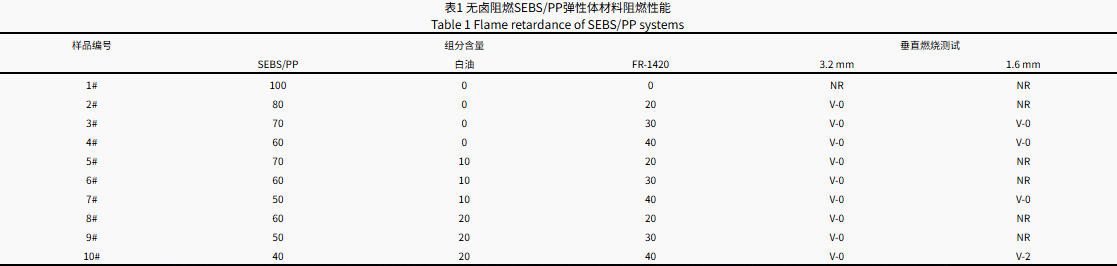
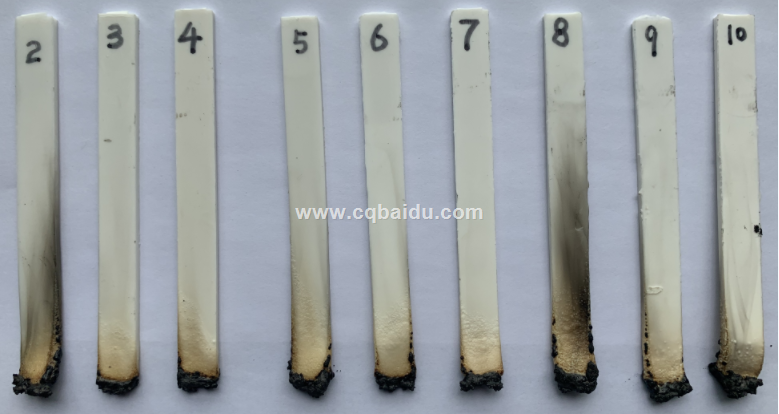
Figure 1 Digital picture of SEBS/PP samples taken after UL-94 tests
2.2 Thermal decomposition behavior of halogen-free flame-retardant SEBS/PP elastomer materials
Thermogravimetric (TG) analysis can be used to study the decomposition of polymer materials under heating conditions, and parameters such as initial decomposition temperature and maximum thermal decomposition temperature can be obtained. It is an important means of studying the flame retardant mechanism of polymer materials. Table 2 shows the TG data of halogen-free flame-retardant SEBS/PP elastomer materials under nitrogen atmosphere. Figure 2 shows the TG and DTG curves of materials with different formulations. Under a nitrogen atmosphere, the initial decomposition temperature of pure SEBS/PP base material (initial decomposition temperature is 5% of the sample's thermal weight loss temperature) is 399 ℃, and the weight loss plateau mainly occurs at 400-500 ℃. The maximum thermal decomposition temperature is 449 ℃ in the middle of the plateau, and the maximum weight loss rate is 2.17%/min. The weight loss is mainly due to the thermal decomposition of SEBS and PP base materials under an inert atmosphere. The residual carbon at 600 ℃ is 0.47%, indicating that the SEBS/PP elastomer base material decomposes almost all combustible gaseous products at high temperatures.
Without oil filling (2 # -4 #), after adding flame retardant FR-1420, the initial decomposition temperature of the sample gradually decreases with the increase of flame retardant content, while the residual carbon at 600 ℃ gradually increases with the increase of flame retardant content. The maximum thermal decomposition temperature is not much different from that of the base material SEBS/PP, mainly due to the thermal decomposition of the base material. Under the condition of oil filling (5 # -10 #), the thermal decomposition of the material is divided into two platforms. The first weight loss platform occurs at 300-400 ℃, mainly due to the thermal decomposition of white oil and flame retardants. The second weight loss platform occurs at 400-500 ℃, mainly due to the thermal decomposition of the base material. The maximum weight loss rate gradually decreases with the increase of flame retardant, indicating that the addition of flame retardant delays the decomposition rate of the material. The residual carbon at 600 ℃ is mainly related to the content of flame retardants. White oil completely decomposes at high temperatures, and its content does not affect the amount of residual carbon.
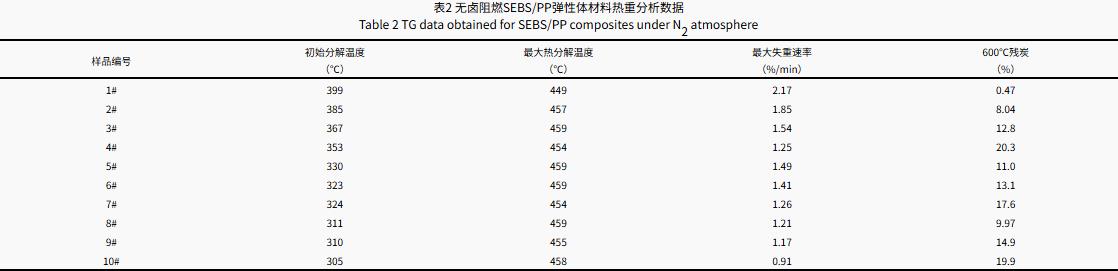
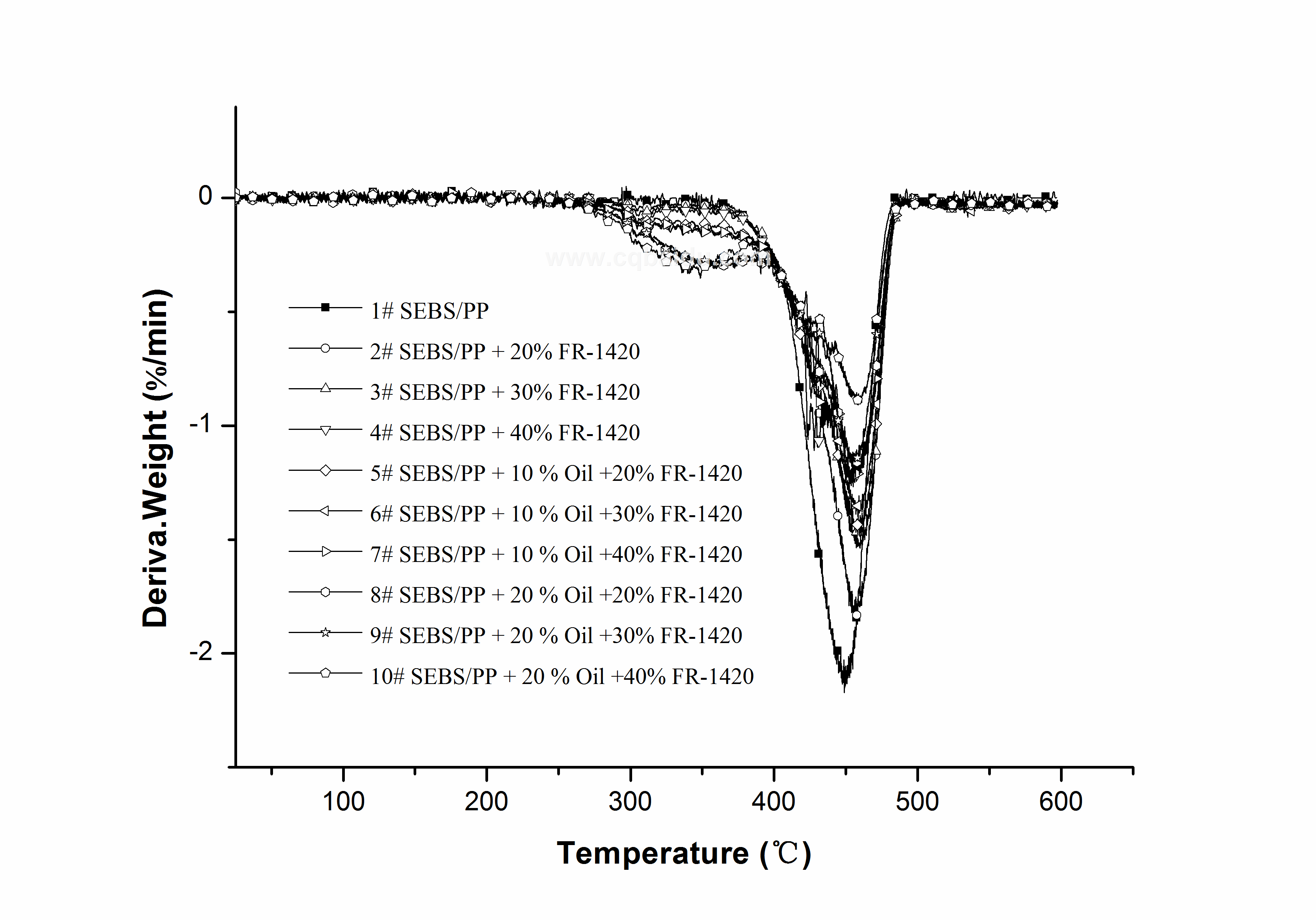
Figure 2 TG and DTG curves of SEBS/PP composites under N2 atmosphere
2.3 Mechanical properties of halogen-free flame-retardant SEBS/PP elastomer materials
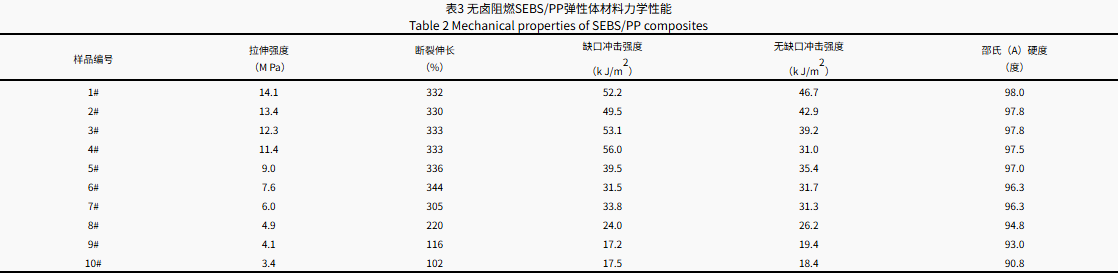
The addition of powder flame retardants as rigid particles can cause changes in the mechanical properties of materials, such as a decrease in tensile strength and impact strength; The addition of white oil can adjust the softness and hardness of the elastic material on one hand, and on the other hand, it also has a significant impact on the tensile strength, impact strength, and other properties of the material. Table 3 shows the mechanical performance data of halogen-free flame-retardant SEBS/PP elastomer materials under different formulations. The Shore hardness and SEBS/PP of the unfilled samples (2 # -4 #) did not change significantly, while the addition of flame retardant FR-1420 reduced the tensile strength and impact strength of the material; After adding 10% white oil, the Shore hardness of the material decreased, and both the tensile strength and impact strength showed a significant decrease. This is mainly because with the addition of white oil, the content of SEBS elastomer in the base material will relatively decrease. At the same time, white oil, as a small molecule softener, will enter between the molecular chains of the elastomer material, weaken the intermolecular forces, and lead to a decrease in the mechanical properties such as tensile strength and impact strength of the material [16].
3 Conclusion
1) The halogen-free flame retardant FR-1420 has a good flame retardant effect on SEBS/PP elastomer materials. Adding 20% FR-1420 can achieve UL94V-0 grade for 3.2mm splines; After adding white oil, the flame retardant performance of the material decreases, and the higher the white oil content, the higher the required amount of flame retardant added.
2) The addition of halogen-free flame retardant FR-1420 advances the initial decomposition temperature of SEBS/PP elastomer material and increases the residual carbon content. The flame retardant acts as a flame retardant by solid-phase expansion into carbon; After adding white oil, the initial decomposition temperature of the material is further reduced, and the white oil completely decomposes at high temperatures. The white oil content does not affect the residual carbon content of the material at high temperatures.
3) After the addition of halogen-free flame retardant FR-1420, the mechanical properties of SEBS/PP elastomer material did not significantly decrease, and the Shore (A) hardness remained unchanged; After adding white oil, the mechanical properties of the material decrease significantly, but it can significantly improve the material's softness and hardness.
References
[1] Wang YT, Zhang SJ, Chu LQ, et al. Research progress of flame-retardant polyolefin and polyolefin elastomer[J]. China Plastics Industry, 2020, 48(9): 1-5.
[2] Lu CH, Cheng FM, Liu Q, et al. Preparation of EPDM/PP thermoplastic elastomer modified by naphthenic oil[J]. China Elastomerics, 2016, 26(3): 28-32.
[3] Zhou DF, Lin JS, Luo Y, et al. Effects of naphthenic oil on PP/EPDM dynamic vulcanized thermoplastic elastomer[J]. Engineering Plastics Application, 2019, 47(2): 131-137.
[4] Ni Z, Lin YH, Guo Z, et al. Research and development of SEBS/PP blends[J]. Plastics, 2020, 49(2): 99-104.
[5] Liu YZ, Guan XP, Xu YC, et al. Influence of different oil-extended crafts on PP modified by oil-extended SEBS[J]. China Plastics Industry, 2012, 40(11): 35-38.
[6] Liu YZ, Guan XP, Xu YC, et al. Study on property of PP modified by oil-extended SEBS[J]. China Plastics Industry, 2020, 40(3): 61-64.
[7] Ni Z, Guo Z, Chen GL. Thermal decomposition kinetics of flame retardant properties of SEBS/PP blends[J]. Heilongjiang Science, 2019, 10(14): 10-13.
[8] Zhou LX, Zhou WP, Zhou LY. A study on flame-retardant technology of SEBS[J]. Fine Chemical Intermediates, 2006, 36(3): 52-54.
[9] Liu SM, Yuan JX, Ge JJ, et al. Influence of PP-g-MAH on the structure and properties of SEBS/PP/MH/EG flame-retardant composites[J]. China Plastics Industry, 2012, 40(6): 70-73.
[10] Zhang WL, Jiang Y, Dai YJ, et al. Properties of SEBS/SEBS-g-MAH/PP flame retardant composites[J]. Plastics, 2018, 47(3): 20-22.
[11] Chen L, Wang YZ. A review on flame retardant technology in China. Part I: development of flame retardants[J]. Polymer for Advanced Technologies, 2010, 21(1) : 1-26.
[12] Pan YJ, Xu JB, Lin CW, et al. Study on SEBS/PP blend flame retarded by APP/PER[J]. China Plastics Industry, 2008, 36(2): 59-61.
[13] Hu Z, Zhong ZQ, Gong XD. Flame retardancy, thermal properties, and combustion behaviors of intumescent flame-retardant polypropylene containing (poly) piperazine pyrophosphate and melamine polyphosphate[J]. Polymers for Advanced Technologies, 2020, 31: 2701-2710.
[14] Levchik GF, Levchik SV, Lesnikovich AI. Mechanisms of action in flame retardant reinforced nylon 6[J]. Polymer Degradation and Stability, 1996, 54: 361-363.
[15] Liu Y, Wang DY, Wang JS, et al. A novel intumescent flame-retardant LDPE system and its thermo-oxidative degradation and flame-retardant mechanisms[J]. Polymer for Advanced Technologies, 2008, 19: 1566-1575.
[16] Zhan SS, Yuan B, Mou XJ, et al. Study on properties of oil-extended SEBS/PP thermoplastic elastomer and its preparation[J]. China Plastics Industry, 2015, 43(1): 46-50.
Attachment: Author Introduction
Hu Zhi (1982-), male, from Chongqing, holds a PhD and is an associate researcher. His main research direction is the theoretical and applied research of new materials for coal mines and polymer modified materials. E-mail: huzhi82@163.com .
Contact phone number: 159-2357-5327; 023-68683249.
Mailing address: Chongqing Kejufu New Materials Co., Ltd., No. 12 Xike Avenue, Yongwei Electric Park, University City West, Shapingba District, Chongqing.
Postal Code: 401332